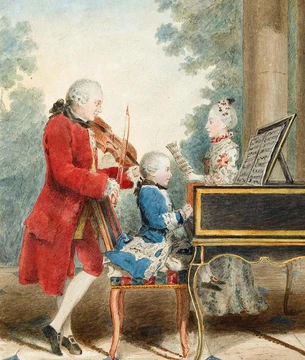
Leopold Mozart
Father and teacher of Wolfgang Amadeus Mozart; violin pedagogue.

- field
- Composer, violinist, music theorist
- nationality
- German
- known_for
- Father and teacher of Wolfgang Amadeus Mozart; author of Versuch einer gründlichen Violinschule
Lore & Background
Leopold Mozart was born in Augsburg, son of a bookbinder and his second wife. He sang as a choirboy, studied at a Jesuit school, and appeared in student theater productions as an actor and singer, becoming a skilled violinist and organist. Although his parents planned a career for him as a Catholic priest, this was not his own wish. He withdrew from the St. He took the family on extensive concert tours throughout central and western Europe, including Munich, Vienna, Pressburg, Paris, the Hague, and London. The touring continued into the early 1770s, with the last three trips to Italy involving only father and son.
Reader's Guide
Leopold Mozart's significance rests on two pillars: his pedagogical work and his role as the father and teacher of Wolfgang Amadeus Mozart. It remains consulted by musicians interested in 18th-century performance practice. Scholars disagree on whether these tours were financially profitable, with some arguing they produced long-term profits and others stating income generally only covered expenses. His failure to advance beyond deputy Kapellmeister is attributed to the long absences from Salzburg caused by the tours. His legacy is thus intertwined with his son's, but his own contributions to violin pedagogy remain independently recognized.
Did You Know?
- The copper engraving for his first musical publication, the six Trio Sonatas, Opus 1, was done by a professional engraver, not by Leopold himself.
- Only two of his seven children survived infancy: Nannerl and Wolfgang Amadeus.
A Composer in the Age of Classical Transformation
Leopold Mozart composed and performed within a musical world that was undergoing a fundamental reorientation. The era he inhabited—roughly spanning 1750 to 1820—sat squarely between the dense, layered Baroque tradition and the emotionally expansive Romantic movement that would follow. In this transitional landscape, the dominant texture shifted toward homophony: a single, clearly articulated melody line floating above a subordinate chordal accompaniment, rather than the interwoven polyphonic voices that had characterized the previous century. The prevailing aesthetic, often described as style galant, prized lightness and elegance over the dignified grandeur of Baroque writing. Composers of this generation, Leopold included, worked in a world where variety and internal contrast within a single movement became more pronounced, and where the orchestra itself grew larger in size, wider in range, and more powerful in collective sound. Counterpoint had not vanished entirely, lingering in liturgical vocal writing and later secular instrumental works, but the overall direction pointed decisively toward transparency and directness of expression.
The Philosophy of Clarity and Order
The musical sensibility of Leopold Mozart's era was deeply shaped by a broader cultural turn toward Neoclassicism, a movement in architecture, literature, and the visual arts that looked back to the ideals of Classical Greece. In music, this translated into a preference for formality, hierarchical structure, and a cleaner, more divided approach to composition—distinct melodic lines set against clearly defined harmonic support, with brighter internal contrasts and expressive use of dynamic shifts and modulations. Underpinning this taste was the public's growing familiarity with Newtonian physics, which had established a paradigm that structures should be logically grounded, well-articulated, and orderly. This philosophical climate pushed music away from the richly layered polyphony of the Baroque toward a simpler, more audibly tonal architecture. Chords became a far more visible structural element, even when they occasionally interrupted the smooth flow of an individual melodic voice. The result was a musical language in which the underlying tonal framework of a piece became far more immediately perceptible to a listener, favoring intellectual clarity over ornamental complexity.
The Practical Realities of Performance and Patronage
The day-to-day working conditions of a composer like Leopold Mozart were shaped by shifting economic and social structures. As the eighteenth century progressed, the nobility became the principal patrons of instrumental music, while public audiences increasingly gravitated toward lighter, comic operatic fare. This dual audience structure meant that composers had to write for standardized instrumental groups rather than the flexible, ad-hoc ensembles of the Baroque era. The basso continuo—the flexible keyboard-and-bass foundation that had underpinned Baroque performance—grew steadily less central, and by the turn of the nineteenth century was nearly extinct outside of occasional liturgical use. The harpsichord, which plucked strings with quills and produced a uniform volume regardless of touch, gave way to the piano, whose leather-covered hammers allowed a performer to shape dynamics and expression through touch. Furthermore, the constant demand for fresh material meant that new works had to be playable after only one or two rehearsals, a practical constraint that influenced how composers notated dynamics, phrasing, and ornaments with increasing specificity rather than leaving them to performer improvisation.
The Instrumental and Vocal Landscape of the Era
The musical world in which Leopold Mozart worked offered a rich taxonomy of forms across both instrumental and vocal domains. On the instrumental side, the principal genres included the sonata, the trio, the string quartet, the quintet, the full symphony performed by an orchestra, and the solo concerto—a work spotlighting a single virtuoso on violin, piano, flute, or another instrument against an orchestral backdrop. Vocal music remained equally vital, encompassing solo songs for voice and piano, choral compositions, and the staged drama of opera. The economic realities of the period further shaped what composers wrote: while a major Baroque-era composer might command the full musical resources of an entire town, a composer attached to a smaller court or aristocratic household faced a more limited and fixed ensemble. This constraint encouraged both the writing of simpler ensemble parts and the crafting of spectacular, idiomatic solo passages for particularly gifted players. The relentless public appetite for new works meant that composers had to produce continuously, balancing technical ambition with the practical demands of a performing world that offered little time for extended preparation.
Frequently Asked Questions
What role did Leopold Mozart play in Wolfgang's career?
He composed, taught, and managed the young Wolfgang's early public performances across Europe, essentially serving as both his private tutor and his professional agent during the family's touring years.
Why is Leopold Mozart important to classical music history?
As a composer, performer, and theorist, he contributed to the development of violin technique and chamber music in the pre-Classic era. His lasting legacy, however, is inseparable from the fact that he nurtured one of the most prolific and influential composers in Western music.
More in Classical Virtuosi 1-24
Elsewhere in the Classical Virtuosi universe
Spotted an error? Know more?
This is a living reference — every entry is fact-audited, and reader corrections feed straight into our audit queue. Suggest an edit · See this site's audit record